US defence secretary's absence at NATO meeting highlights transatlantic shift

Washington has welcomed recent efforts by European NATO members to take on more responsibility within the alliance, according to Elbridge Colby, the third-ranking official at the US Department of Defense. He spoke ahead of Thursday’s meeting of NATO Defence ministers in Brussels. US Defence secretary Pete Hegseth did not attend the meeting.
The stepped-up efforts by European allies provide "a very strong basis for working together in partnership, with a NATO 3.0 based on partnership rather than dependency", Colby said, adding that the alliance is returning to its original purpose of defence and deterrence.
The reason for Hegseth’s absence was not disclosed. At the NATO headquarters, some interpreted his decision not to attend as a sign that Washington now considers the alliance to be less important than before. Secretary of State Marco Rubio was also absent from the most recent meeting of Foreign Affairs ministers in December.
Shifting responsibilities
"As the United States will have to focus more on the situation in and around the Pacific in the future, it is crucial that Europe and Canada take on more responsibility," NATO secretary general Mark Rutte said on Thursday. That process is already underway: earlier this week, NATO announced that several senior command positions will be transferred from the US to European allies.
Specifically, the United Kingdom will take over command of Joint Force Command Norfolk in the US state of Virginia. Italy will become the head of Joint Force Command Naples, and leadership of Joint Force Command Brunssum in the Netherlands will rotate between Germany and Poland. The changes will be introduced gradually over the coming years.
"The US remains committed to NATO command and control"
NATO stressed that this does not mean the US is turning its back on the alliance. According to a NATO statement, the agreement forms part of "a shift towards a fairer distribution of responsibilities" within the alliance. "The US remains committed to NATO command and control," the statement says, for example by continuing to hold the post of Supreme Allied Commander Europe.
Changes are expected to remain limited to those already announced by Washington, according to a senior NATO diplomat. Several NATO sources have also said that any adjustments are unlikely to be "dramatic" in the short term.
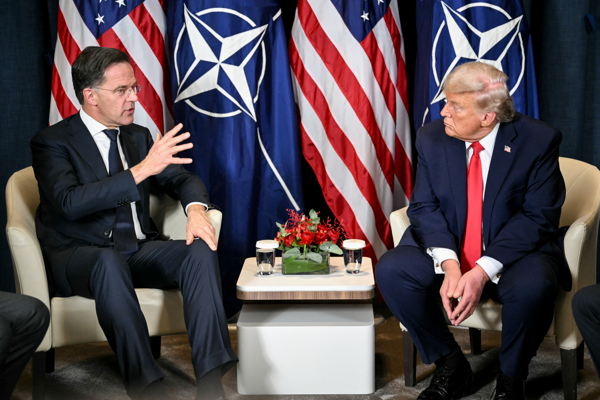
US under secretary of war for policy, Elbridge Colby, and NATO secretary general Mark Rutte. PHOTO © JOHN THYS / AFP
Related news