ECB keeps interest rates unchanged

The European Central Bank (ECB) has left interest rates unchanged, maintaining its key deposit rate at 2 per cent, the bank announced on Thursday.
The decision reflects a cautious approach amid rising uncertainty due to the war in the Middle East. While monetary policy remains on hold for now, the ECB warned that the conflict is already affecting the economic outlook, particularly through higher energy prices.

The ECB has revised down its growth forecasts for the coming years. The eurozone economy is now expected to grow by 0.9 per cent in 2026, compared with a previous estimate of 1.2 per cent. Growth in 2027 is also expected to be slightly lower, at 1.3 per cent instead of 1.4 per cent, while the 2028 forecast remains unchanged at 1.4 per cent.
Inflation pressures rise
Inflation is now projected to reach 2.6 per cent this year, up from an earlier estimate of 1.9 per cent. Forecasts for 2027 and 2028 have also been revised slightly upwards.
“The war in the Middle East has made the outlook significantly more uncertain, creating upward risks for inflation and downward risks for economic growth,” the ECB said.
“That will have a material impact on inflation in the short term due to higher energy prices. The effects in the medium term will depend on the intensity and duration of the conflict and the ripple effect of energy prices on consumer prices and the economy.”
The ECB continues to target an inflation rate of 2 per cent over the medium term.
The decision to hold rates was widely expected by analysts, many of whom anticipate a wait-and-see approach in the coming months. Some expect a possible rate increase later in the summer. Higher interest rates typically make borrowing more expensive, slowing demand and helping to bring down inflation.
The ECB said incoming economic data would be key in assessing how the conflict affects inflation and growth. The Governing Council, led by ECB president Christine Lagarde, is monitoring developments “closely” and will continue to take a data-driven approach.

ECB prepared for uncertainty
Lagarde said the central bank is ready to respond if needed. “We are both well-placed and well-equipped to deal with the development of a major shock that is now unfolding,” she said. “We are going to continue doing what we have done so far.”
Before the latest escalation in the Middle East, inflation in the eurozone had been stabilising and economic growth remained modest. The ECB has previously faced criticism for reacting too slowly to rising prices following the start of the war in Ukraine in 2022.
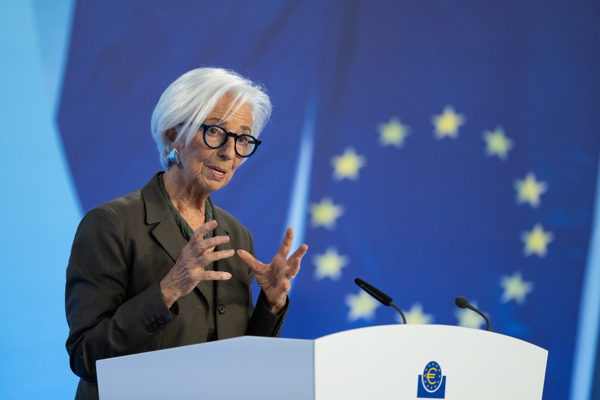
Christine Lagarde, president of the European Central Bank (ECB), speaks at the press conference after the Governing Council meeting of the ECB on 19 March 2026, Hesse, Frankfurt/Main. PHOTO MICHAEL BRANDT / DPA
Related news