Number of non-European migrant workers in Flanders continues to rise

The number of migrant workers coming to Flanders from outside the European Union continues to rise, mainly due to persistent shortages in specific sectors and bottleneck positions. That shows the annual report of the Flemish Economic Migration Service.
Traditional free movement within the EU is stagnating. The number of workers from Central and Eastern Europe is no longer increasing and some countries are themselves facing shortages, so that Flanders is beginning to lose its competitive advantage. Due to this stagnation, there is an increasing focus on recruiting third-country nationals.
The number of migrant workers from outside the EU has thus been on the rise in recent years. In 2025, 27,561 applications and 23,989 approvals were registered. These numbers are significantly higher than the figures for the previous year: 23,347 applications (+18.1 per cent) and 20,048 approvals (+19.7 per cent).

Of the total number of applications, 9,998 were renewals. In addition, the number of applications (1,139) and approvals (749) for permanent work permits is also increasing. “The Flemish government wants to make sustainable use of foreign talent and integrate it into the Flemish labour market and society,” stated the Economic Migration Service.
Of the 28,000 current work permits in 2025, highly skilled workers form the largest group (58 per cent). India remains the main country of origin for highly skilled foreign workers – mainly active in consultancy and information technology – followed by China, Turkey, Japan and Iran.

Within the “medium-skilled” cluster (20 per cent of the total), workers of Turkish nationality are the largest group, followed by Filipinos. Transport is the largest sub-sector in this category. Last year, most work permits were issued to lorry drivers, followed by care workers and maintenance mechanics.
In addition to seasonal workers, the “other” category includes other bottleneck positions for which the employer can demonstrate that no candidates are available. From this year onwards, low-skilled profiles are explicitly excluded from this category. Economic migration for seasonal workers, who are allowed to stay for a maximum of 90 days, has on the other hand been simplified.
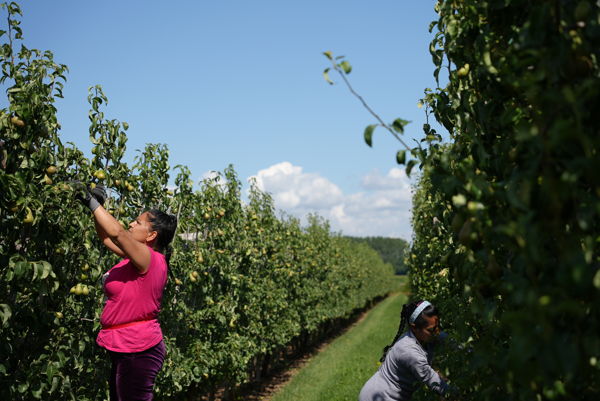

Ukrainian seasonal workers form the largest group within the latter category. They mainly work in fruit growing and agriculture in Limburg province. It is striking that the vast majority of seasonal workers are women (82 per cent). The typical seasonal worker thus differs from the typical labour migrant, who is predominantly male.
Most foreign workers are active in Limburg, followed by the provinces Flemish Brabant, Antwerp – with a large number of highly educated workers – East Flanders and West Flanders. Ukrainians make up the largest group, followed by Turks, Indians, Moroccans and Filipinos.
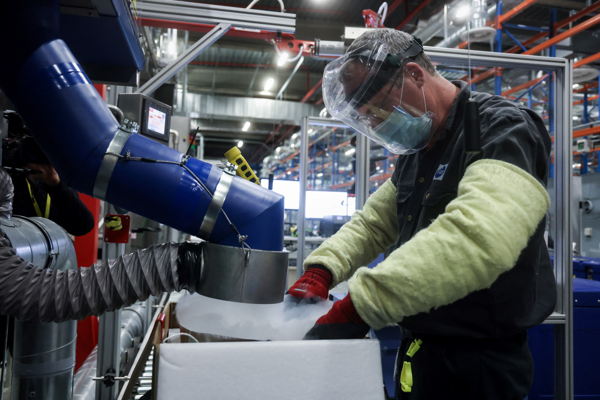
#FlandersNewsService | Clean room at Imec, in Leuven © BELGA PHOTO NICOLAS MAETERLINCK
Related news