New study: Pension reform widens gender gap among employees and self-employed

The federal government’s pension reform will widen the gender pension gap among employees and the self-employed, but not among civil servants. This shows the Planning Bureau’s impact studies, presented to the Chamber on Monday. The Planning Bureau concludes that the government is curbing the costs of an ageing population, but that this is accompanied by lower average pensions, increasing pension inequality and a greater risk of poverty.
In a first study examining the budgetary impact, the Planning Bureau concludes that the reform curbs the rise in pension expenditure. For instance, the budgetary costs of an ageing population – the difference in social expenditure between 2024 and 2070 as a percentage of GDP – will fall by 1.3 percentage points compared to a scenario without these measures. This amounts to a reduction of around one-third, as the government had projected.
But the reform has social consequences. For instance, the average gross pension of new pensioners will be lower than it would be without the reform. The decline will be most pronounced among civil servants (-15.2 per cent in 2070). For employees (-7.2 per cent) and the self-employed (-3.2 per cent), the impact is more limited.


Criticism of the reform has in recent months focused on the consequences for women. One of the findings of that study is also that the cumulative effect of the measures will be more negative for women than for men among employees and the self-employed. For example, there will be a negative effect of -6.6 per cent by 2070 for female employees on the ratio between the average pension and the average professional income, the so-called “benefit ratio”. For men, this stands at -5.8 per cent. For the self-employed, the figures are -4.4 per cent and -2.9 per cent respectively.
By contrast, the gender pension gap among civil servants is narrowing. For instance, there is a negative impact on the “benefit ratio” for men of -13.8 per cent. For female civil servants, this stands at -12.8 per cent. According to the Planning Bureau, the narrowing of the gender pension gap among civil servants is attributable to the reform of preferential schemes, such as those for military personnel and train crew, where men are over-represented.

The second study on distributional effects indicates that pension inequality is also increasing. This is partly due to welfare adjustments that the government has suspended until the end of the legislative term. The ratio of the “D10/D1 index” – the average of the top 10 per cent of gross pensions compared to the bottom 10 per cent –rises by 9.1 per cent by the end of the legislative term. Taking into account household composition and total net income, this represents an increase of 1.5 per cent.
Finally, it is also striking that the simulated risk of poverty among new pensioners rises from 5.9 per cent to 6.3 per cent by the end of the legislative term. For all pensioners combined, there is an increase from 5.5 to 6.1 per cent. The main explanation for this is, once again, the suspension of welfare adjustments, in particular those for minimum pensions.
The Social Affairs Committee has approved the pension reform at first reading, but a vote at second reading in the committee is still to follow. The aim is to have everything voted through before the summer.
Reaction socialist trade union
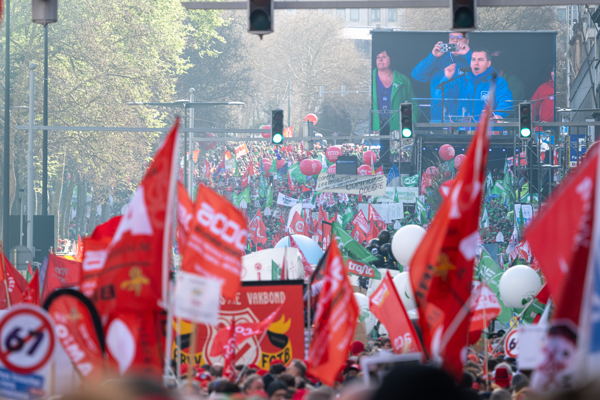
For the socialist trade union ABVV, the findings of the Planning Bureau confirm what the union has been saying for months. “This is purely a cost-cutting exercise,” stated chairman Bert Engelaar. “Once again, it has been demonstrated that this ‘reform’ will burden future generations with lower pensions.”
The trade unions are organising another demonstration in Brussels on 12 May. “The call for a fair pension policy will once again ring out loud and clear,” said Engelaar. The union also intends to continue the legal battle against the reform.
Minister of Pensions Jan Jambon © BELGA PHOTO ERIC LALMAND
Related news