Flemish politicians favour self-promotion over negativity on Facebook

Flemish Members of Parliament predominantly use Facebook to share positive, self-promotional content rather than to criticise political opponents, according to a long-term study by the University of Antwerp (UAntwerp) analysing around 250,000 posts from the past 15 years.
Led by Peter Van Aelst, researchers examined the Facebook activity of 350 MPs, covering posts dating back to around 2010, when the platform began to gain widespread use among politicians. The dataset includes contributions from Flemish representatives in both the federal and Flemish parliaments.
Large-scale data analysis
“We looked at a very long period, going back to 2010,” said Van Aelst. In collaboration with the Department of Computational Linguistics, the team carried out an extensive language-based analysis using self-trained large language models (LLMs), a form of artificial intelligence designed to detect emotional tone in text.
“Facebook allows us to go back a very long time in the analyses. So we didn't take a sample, but really looked at all 250,000 posts we could find,” added Van Aelst, professor of political and social sciences at UAntwerp. Visual content, such as posts shared via Instagram, was not included in the study.
“The main emotion is joy"
The researchers found that about 60 per cent of posts were positively framed, 20 per cent were neutral and 20 per cent were negative. “The main emotion is joy,” said Van Aelst. “Enthusiasm recurs very often in what politicians send out into the world. They present themselves to their followers as proud and hopeful.” He added that “the negativity pales in comparison to the increase in cheerful posts.”
Although anger was the most common emotion in negative posts, these were far less prominent overall. Instead, politicians tend to focus on promoting themselves rather than criticising rivals. A significant share of posts highlight their personal lives, and these are almost always positive in tone.
“Such posts also led to more reactions, and the members of parliament have clearly learned that,” said Van Aelst. “It is purely about personal promotion. Something like: 'Look, I went to a barbecue or to the Ghent Festivities; look what I’m doing. I am present in society at numerous activities, whether party-affiliated or not.'”
Perception versus reality
The study also identified a strong presence of messages emphasising solidarity, such as people helping each other in difficult times. According to the researchers, these posts are far more common than critical or confrontational messages.
“These are, therefore, a lot more important than posts in which politicians criticise their colleagues. Of course, the media do tend to pick out those posts more often,” said Van Aelst. “Perhaps partly because of this, people overestimate the proportion of negative posts or statements that are crude. People remember negative things better.”
Further research to come
For now, only preliminary findings have been released, with full scientific publications to follow. “Although we will be announcing the results at various conferences soon,” Van Aelst concluded. The research team plans to explore additional questions later this year, including whether emotional intensity is increasing and whether younger politicians communicate differently online.
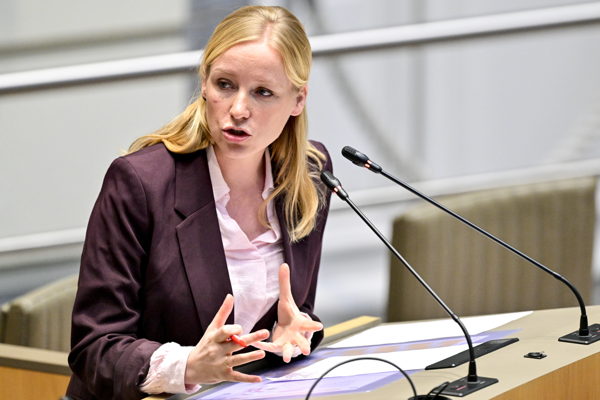
#FlandersNewsService | © PHOTO QUENTIN DE GROEVE / HANS LUCAS VIA AFP
Related news