Flemish government relaxes arms trade rules and invests in defence innovation

The Flemish government has approved a new draft arms trade decree to facilitate the legitimate trade in military goods, civilian firearms, essential components and ammunition, alongside a Flemish Innovation and Industrial Strategy for Security and Defence. The measures signal increased investment in Belgium’s defence and a stronger focus on cooperation with Europe and NATO, minister-president Matthias Diependaele (N-VA) announced.
Under the new decree, Flemish companies should be able to supply military goods and components more easily within the European Union and to established partner countries, such as NATO allies. Procedures for cooperation within Europe will be simplified, and processing times will be shortened.
Safeguards and export restrictions
The government noted that existing safeguards will remain in place. The export ban on weapons to Israel will continue to apply, while a full permit procedure and thorough end-use inspections will remain mandatory for high-risk destinations, including countries subject to sanctions or affected by armed conflict.
The previous arms trade decree was last amended in 2017. According to the government, the defence industry has long considered it overly complex and inflexible. In some respects, it also went beyond European requirements, a practice known as “gold plating”, which the new legislation seeks to eliminate.
Alongside the decree, the government approved the Flemish Innovation and Industrial Strategy for Security and Defence (VISD), which forms part of the Defence Plan presented in the spring. The VISD sets out a long-term strategy to further develop Flanders’ defence-related industry.
Focus on European and NATO cooperation
Based on federal and European needs, roadmaps will be drawn up around which industrial ecosystems can be built, with a focus on knowledge sharing and economies of scale. Areas in which Flanders already has a strong position include aviation, space travel and artificial intelligence.
Funding will be allocated annually to support the strategy, with a growth path of up to 50 million euros by 2029. Part of this budget will also be used to organise initiatives such as the Defence Innovation Flanders Days.
“Flanders has strong innovative companies and knowledge institutions in the defense and security sector,” says Diependaele. “To allow this Flemish cutting-edge technology to grow from pilot projects into effective projects ready for our own defence or European and NATO cooperation, we are increasing investments. We are currently allocating €5 million for this purpose, with a further increase to €50 million per year by 2029. This will strengthen production in Flanders, exports from Flanders, and the broader picture of our European security.”
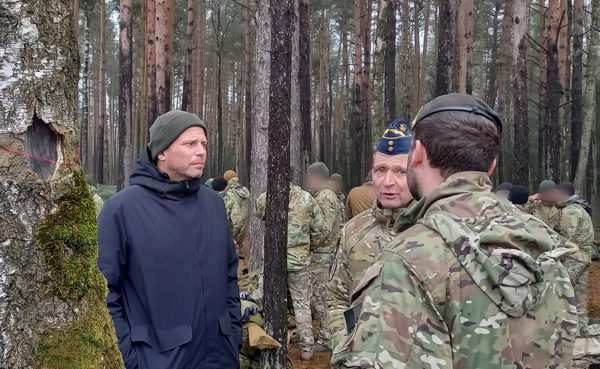
#FlandersNewsService | Soldiers of infantry army take part in a French-Belgian military drill as part of the "Ardennes" international training exercise, in Sissonne, north-eastern France, on December 5, 2025. © FRANCOIS LO PRESTI / AFP
Related news