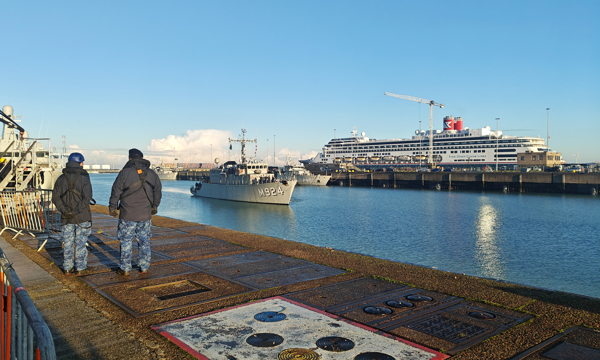
Defence minister sees growing Russian threat during visit to Belgian troops in Lithuania

Defence minister Theo Francken and chief of Defence Frederik Vansina visited Belgian troops in Lithuania on Tuesday, after meeting Lithuanian Defence minister Robertas Kaunas and the country’s general staff. Lithuanian authorities consider a military confrontation between Russia and NATO inevitable.
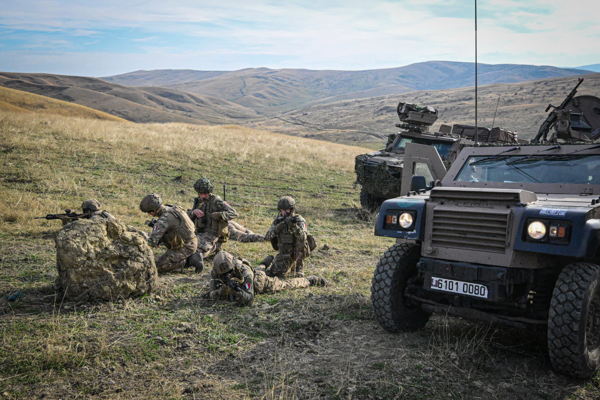
Belgium deployed more than 200 soldiers to Lithuania last summer as part of a NATO mission to reinforce the alliance’s eastern flank. Speaking on the sidelines of his visit, Francken described the region as "a threatened region". "I was able to see with my own eyes how intensively they train."
Francken saw how the persistent Russian threat is perceived in the Baltic states. "Moscow has never been able to digest the loss of the Baltic countries in 1991, and Dmitri Medvedev calls them ‘our Baltic provinces’," he said. "NATO must form a strong fist against that."
"I have been here since 2021, and the Lithuanians are really preparing for war"
The Belgian contingent is stationed at the Rukla military camp and forms part of a NATO battlegroup of around 1,400 troops under German command. Belgian soldiers take part in joint exercises alongside forces from Germany, Norway, the Netherlands, Luxembourg and Lithuania.
One Belgian soldier said the atmosphere increasingly felt less like training. "I have been here since 2021, and the Lithuanians are really preparing for war." That assessment was echoed by his commanding officer. "Among the population and the Lithuanian soldiers we meet, the same feeling prevails everywhere: it is not a question of whether there will be an invasion, but when."
Eastern flank under threat
Lithuania also voiced its concerns about the security of Europe’s eastern flank on Tuesday at a summit in Helsinki, where leaders from eight northern and eastern European countries called for immediate action in response to the Russian threat.
In a joint statement, the leaders of Finland, Sweden, Latvia, Lithuania, Estonia, Poland, Romania and Bulgaria said the situation required "immediate priority" to be given to the defence of the EU’s eastern flank through an operational, coordinated and multi-domain approach.
They called in particular for stronger land forces, improved defence against drones, enhanced air and missile defence, and better protection of borders and critical infrastructure, within the EU framework and in cooperation with NATO.
© BELGA PHOTO NICOLAS BARAS
Related news