EU designates Iran’s Revolutionary Guard as terrorist organisation

The European Union has added Iran’s Revolutionary Guard to its list of terrorist organisations. The decision, taken by EU Foreign ministers on Thursday, follows the violent suppression of anti-government protests at the end of last year and the beginning of this year, in which thousands of people were killed, according to NGOs.
The plan to designate the elite corps of the Iranian regime as a terrorist organisation has been circulating for some time, but unanimity among member states had so far been lacking. In recent weeks, Germany and Italy publicly backed the move, while France also expressed its support on Wednesday.
Belgium had already included the designation of the Islamic Revolutionary Guard Corps (IRGC) as a terrorist group in its coalition agreement. "This designation reflects the horrific crimes committed by the IRGC," Foreign minister Maxime Prévot wrote on X on Thursday. "Torture. Brutal repression of peaceful protesters. The execution of young people whose only crime was demanding freedom."
"This designation reflects the horrific crimes committed by the IRGC"
Once the Revolutionary Guard is formally placed on the terrorist list, its members will be subject to an entry ban and a prohibition on doing business within the EU. The move is largely symbolic, as the organisation is already subject to a wide range of EU sanctions, including measures aimed at preventing nuclear proliferation.
The sensitivity of the issue explains the long delay. The EU rarely labels a state body as a terrorist organisation, and the decision could have repercussions for European citizens held in Iranian prisons, including Swedish-Iranian VUB professor Ahmadreza Djalali. It is also unclear how many EU nationals were arrested during the protests.

More sanctions
In parallel with the designation, the EU agreed on sanctions against a further 15 individuals and six entities deemed responsible for "serious human rights violations" linked to the crackdown.
Those targeted include Iranian Interior minister Eskandar Momeni and prosecutor general Mohammad Movahedi-Azad. The sanctioned entities include the Iranian media regulator SATRA and several software companies linked to censorship campaigns, the spread of online disinformation, or the disruption of internet access in Iran.
In total, the EU has now imposed sanctions on 247 individuals and 50 entities in Iran over human rights violations. The measures include asset freezes within the EU and travel bans.
Brussels protest
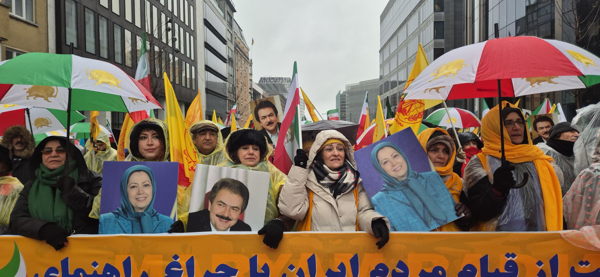
Meanwhile, the Iranian-Belgian non-profit organisation Mala Kurd, working closely with human rights group Hengaw, displayed the names and portraits of victims of the Iranian regime's repression on Brussels’ Place de la Monnaie on Thursday.
"We are displaying the first 1,300 verified portraits with complete details of victims from Iran," the organisation said. The victims range in age from six to fifty. "Some of them were just walking down the street and were not even protesting. This is purely to create fear."
Although protests in Iran have been ongoing since late December, activists say the scale of the repression is only now becoming fully visible. The regime cut off internet access on 8 January, which has been partly restored since this week.
PHOTO © SEPAH NEWS/AFP | VIDEO © BELGA/TIMON RAMBOER
Related news