Dredging group DEME acquitted on appeal in Russian bribery case

The dredging group DEME has been acquitted by the Ghent Court of Appeal in the long-running bribery case surrounding dredging works at the port of Sabetta in northern Russia. The public prosecutor had sought a forfeiture of 12.6 M and a fine of 600,000 euros, but the court cleared DEME and five of its former executives, citing insufficient evidence.
The case centred on a 420 M contract for dredging works at Sabetta, home to one of the world’s largest LNG terminals on the Yamal Peninsula. In 2013, both DEME and Jan De Nul applied for the works after the Russian Ministry of Transport outsourced the tender to USK Most. DEME secured the contract through its Russian joint venture, Mordraga; Jan De Nul did not.

Investigation and disputed emails
Suspicious of a conflict of interest involving an intermediary, Jan De Nul filed a criminal complaint in 2016 with the East Flanders public prosecutor, submitting internal DEME emails as evidence but without explaining how they had been obtained. The investigation later involved the FBI, which in 2018 executed search warrants targeting email accounts.
According to the prosecution, consultancy agreements concluded during the project negotiations were used to conceal bribes. “During the investigation, it was established that the emails were authentic, and that during the project negotiations, DEME NV had concluded several consultancy agreements, for which payments were made during the subsequent execution of the project into various foreign bank accounts,” the court stated in a summary of the facts.
“According to the public prosecutor's office, these agreements were intended to conceal the payment of the bribes. Dredging company DEME NV, the executives involved, and the external consultant consistently denied the facts. According to them, the contract was awarded to MORDRAGA LLC because it had submitted the best bid, and these consultancy agreements related to services provided in connection with the project's execution.”
First instance ruling overturned
In September 2024, the Ghent Criminal Court ruled the proceedings inadmissible, finding that the emails had been obtained unlawfully and that the defendants’ right to a fair trial had been violated. The public prosecutor appealed.

The Court of Appeal disagreed on admissibility. “The fact that evidence may have been obtained unlawfully does not mean that it can never be used in criminal proceedings. Only if the rights of the defence have been irreparably violated as a result can the criminal case be declared inadmissible. This was not the case here.”
No public or private bribery proven
On the substance, however, the court found neither public nor private bribery had been proven. The alleged recipients were not public officials, but private individuals. As for private bribery, the court noted that no investigation had taken place in Russia into the internal decision-making of the Russian company involved.
Without clarity on whether any alleged acts were carried out without the knowledge or consent of its board or shareholders, the offence could not be established.
While the court said it was understandable that investigators had not pursued further inquiries in Russia, particularly given the war in Ukraine, this left “a significant gap in the evidence”. The standard of proof, which is defined as guilt beyond a reasonable doubt, had not been met.
The only remaining legal avenue is an appeal in cassation.
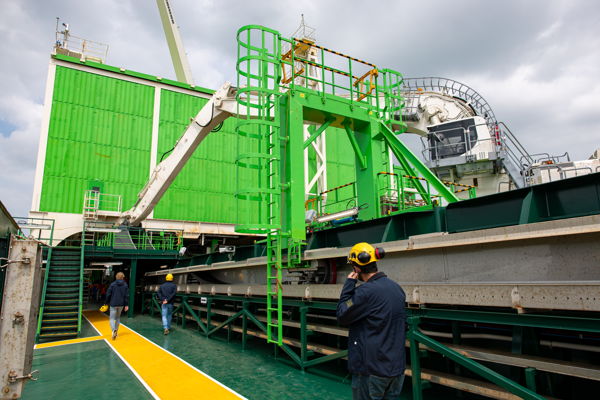
#FlandersNewsService | The presentation of the 'Yellowstone' fallpipe rock installation vessel of offshore infrastructure group DEME, Tuesday 04 June 2024 in Zeebrugge. © BELGA PHOTO KURT DESPLENTER
Related news