PM cautious on energy support amid Middle East tensions

Prime minister Bart De Wever has signalled reluctance to introduce new support measures to ease rising energy costs, warning that Belgium is particularly exposed to the economic fallout from the ongoing war in the Middle East. He made his position clear during a session of the Chamber of Representatives on Tuesday.
"We are carrying a legacy of poor management, rising interest rates, and a massive national debt. Everyone should realise that advocating for big gifts in all directions right now is hardly realistic," De Wever said.
"The budgetary situation is not good"
In recent weeks, most parties in the majority coalition have called for government intervention to curb soaring energy prices. De Wever, however, argued that hasty measures could be counterproductive. "You could learn lessons from what the previous government did: it threw around helicopter money, and that is now a heavy chain dragging the Titanic further to the bottom," he said in the House Committee on Internal Affairs.
"The budgetary situation is not good, and geopolitical circumstances could be an anchor pulling us down even further. Running to the cameras with all kinds of proposals to supposedly save the population is irresponsible," he added.

De Wever also addressed a recent proposal by the employers’ organisation Voka for a full wage index freeze. The government has already decided on a cent index (a limited wage adjustment), he noted. "The fact that we have to keep an eye on wage costs because, unlike other countries, we have an automatic wage correction that is not being questioned, is a known phenomenon," he said. "I would advise everyone to be cautious in public statements. It is better to work on problems in a controlled manner than to propose 25 different solutions every day."
Belgium particularly vulnerable
De Wever emphasised that Belgium is particularly vulnerable to energy shocks given its reliance on imports and previous policy decisions. "We have been left particularly vulnerable due to mismanagement," he said.
Addressing the Israeli-American war in Iran directly, De Wever said it was creating significant economic instability in Europe. "I doubt whether there is an exit plan, and the time that has passed is not of a nature to dispel that doubt. Something has been started that cannot be finished."
He also pointed to Belgium’s energy policy as a key factor in the country’s exposure. "We have further increased our energy dependency in recent years by replacing our nuclear capacity with gas power plants. We are now confronted with the stupidity of that decision. After Malta and Cyprus, we are the most dependent on energy imports. We have been left particularly vulnerable by real mismanagement and are therefore in the front row to take the hits."
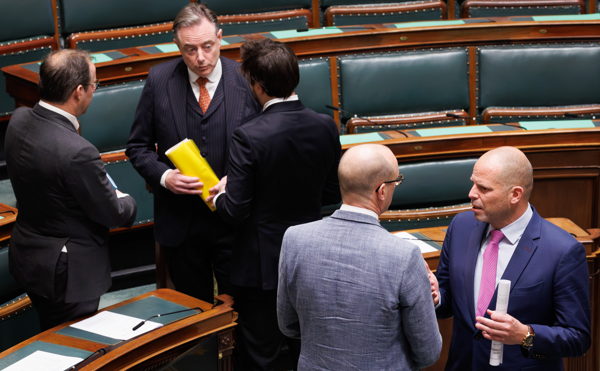
Prime minister Bart De Wever pictured during a session of the Interior Affairs Commission, at the Chamber at the federal parliament in Brussels, on Tuesday 24 March, 2026. © BELGA PHOTO ERIC LALMAND
Related news