OECD: Belgian development aid fell by 17 per cent in 2025

Figures from the Organisation for Economic Co-operation and Development (OECD) show that the amount Belgium spends on development aid fell by 17 per cent in 2025. Belgium is by no means an exception: globally, official development assistance between countries has fallen by 23.1 per cent, the largest decline ever. This is mainly due to the US withdrawal, against a backdrop of budgetary pressures and geopolitical tensions.
For the second year running, the 34 OECD countries are spending less on development cooperation. According to provisional figures, their combined contribution now stands at 174.3 billion euros.
Belgium is also spending less: 2.72 billion dollars in 2025 (0.37 per cent of gross national income or GNI), compared to 3.24 billion dollars (0.48 per centof GNI) in 2024 – a fall of 17 per cent. In 1970, OECD countries agreed to spend 0.7 per cent of their GNI on development aid. Many countries, such as Belgium, cite the numerous international crises and tight public finances as the reason for the cuts.

It was recently revealed that the Flemish government’s official development assistance amounted to almost 43 million euros last year, 28 per cent less than in 2024. In 2025, Flemish development aid accounted for just 1.8 per cent of total Belgian aid, the lowest percentage since 2006.
“The continuing decline in aid is a major shock to the development cooperation system,” the OECD said. For 2026, the OECD expects a further decline of 5.8 per cent.
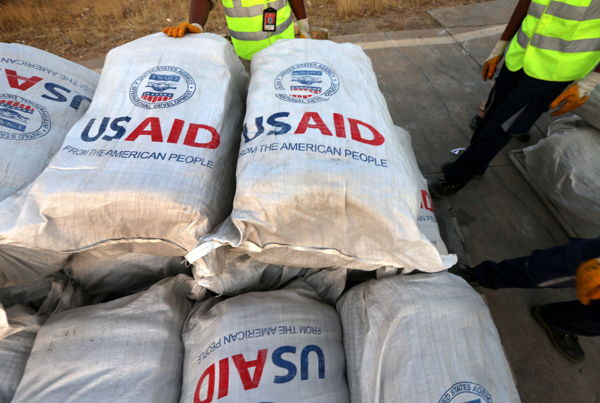
Of the 34 OECD member states surveyed, 26 have cut their development aid, but the United States alone accounted for 75 per cent of the decline. The start of president Donald Trump’s second term, early last year, was accompanied by a drastic reduction in development aid through the dismantling of the USAID agency.

“With these drastic cuts, wealthy governments are turning their backs on millions of people in the Global South,” said Didier Jacobs of Oxfam.
“Given the crucial role of international solidarity in the fight against diseases such as HIV, AIDS and malaria, the Institute of Global Health in Barcelona estimates that global aid cuts of this magnitude will cause hundreds of thousands of deaths in 2025 alone. If this trend continues, such cuts could cost more than 9 million lives by 2030.”
For Oxfam, “international solidarity is needed more than ever, in a world that is becoming increasingly unstable”.
Illustration © PHOTO AMER ALMOHIBANY / AFP
Related news