New satellite with Belgian technology to study the Sun’s influence on Earth

The European Space Agency (ESA) is set to launch the SMILE mission on Tuesday, in collaboration with China, to study the Sun’s influence on Earth. Belgium is making a significant contribution to the mission, the Belgian Science Policy Office (Belspo) announced.
A GPS that suddenly stops working, radio communications that cut out, or blocked electricity grids. The potential source of disruption in all these scenarios is the phenomenon of the solar wind. The Sun emits charged particles that can collide with the Earth’s magnetic field, thereby disrupting technology on Earth and in space. This can, for example, put astronauts in serious danger.
The SMILE mission aims precisely to better map this phenomenon. “Thanks to the new data collected by the satellite, scientists will be able to analyse when and why so-called space weather causes problems,” stated Belspo in a press release. In this way, scientists will in the future be able to predict where disruptions will occur.


Belgium plays a role in both the satellite’s instruments and the research. The Liège Space Centre, for example, contributed to the development of SMILE’s ultraviolet instrument. The University of Liège will help examine the data from that instrument. The Royal Belgian Institute for Space Aeronomy is also a co-investigator, but specifically focusing on the properties of the solar wind.
The SMILE (Solar wind Magnetosphere Ionosphere Link Explorer) will launch on Tuesday from French Guiana, heading for an orbit around the Earth for at least three years.
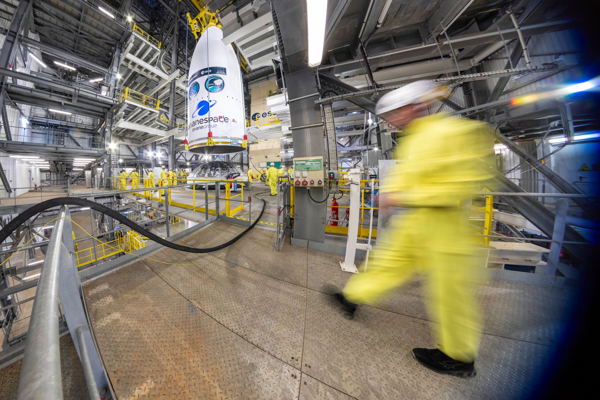
A technician checks the Solar wind Magnetosphere Ionosphere Link Explorer (SMILE) © PHOTO Xinhua/Jin Liwang
Related news