Last Qatari LNG tanker set to reach Zeebrugge amid strait disruption

A final tanker carrying liquefied natural gas (LNG) from Qatar is due to arrive in Zeebrugge on 22 March, marking the last scheduled delivery from the Gulf state as shipping through the Strait of Hormuz remains disrupted. The vessel had already departed before the escalation of the conflict in the Middle East, after which the route was effectively cut off. “It is the last ship from Qatar on the schedule for the time being,” said Fluxys spokesperson Tim De Vil.
Despite the disruption, the immediate impact on Belgium’s gas supply is expected to remain limited. In recent months, Qatar accounted for around 8 per cent of LNG imports to Zeebrugge, while LNG itself represents about 30 per cent of Belgium’s total gas imports. Most gas continues to arrive via pipelines from Norway, France and the United Kingdom.
The gap left by Qatari shipments is already being partially filled. “In April, five slots will become available on the secondary market. At least one of them has already been taken by another supplier,” De Vil said. LNG shipments from the United States, Russia and Nigeria are helping to offset the shortfall, although Russian gas imports will be phased out across the European Union from 2027.
However, the loss of Qatari supply is contributing to higher prices, as Europe competes more directly with Asian markets for LNG.


The broader economic impact of the disruption is uneven across Europe. According to a study by the Austrian institutes Supply Chain Intelligence Institute Austria and Complexity Science Hub (CSH) and Delft University of Technology from the Netherlands, Belgium is among the countries most affected, alongside Italy and the United Kingdom.
Belgium imports around 5.8 billion dollars’ worth of LNG from Qatar each year, in addition to significant diamond trade flows from the United Arab Emirates via Antwerp. While diamond trade is less critical to supply chains, the country’s role as a gas transit hub increases its exposure.
The study suggests that the duration of the disruption will be key. If the blockade lasts more than four weeks, the economic consequences could increase significantly due to knock-on effects in global supply chains.
Calls to reopen the Strait
NATO secretary general Mark Rutte expressed confidence that a solution could be found. “I am convinced that our allies, as always, will do everything possible to defend our common interests,” he said. “We will find a way out.”
“Everyone agrees that this strait cannot remain closed. It must reopen as soon as possible,” Rutte added. “This is crucial for the global economy.”
International response
Meanwhile, a group of six countries - Germany, France, Italy, Japan, the Netherlands and the United Kingdom – said they were prepared to contribute to “appropriate measures to guarantee safe passage through the Strait of Hormuz.”
In a joint statement, the countries condemned Iranian attacks on merchant shipping and energy infrastructure, and called on Tehran to halt actions that are blocking the waterway. They also signalled plans to help stabilise energy markets, including discussions on increasing oil production.
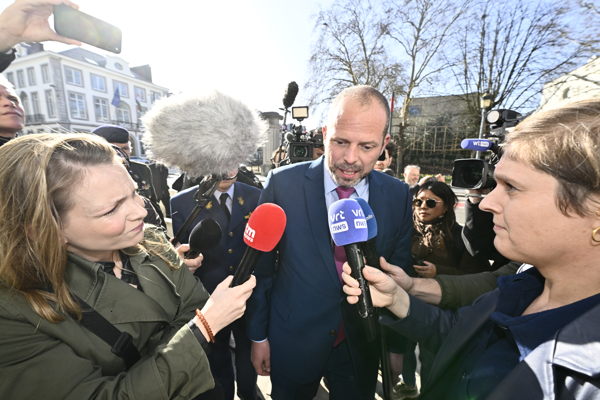
© BELGA PHOTO NICOLAS MAETERLINCK
Related news