Core cabinet ties up outstanding budget issues

The federal government’s core cabinet reached an agreement on Thursday night on issues left unresolved in the multi-year budget, according to several government sources. Key issues that remain outstanding include the deployment of military personnel on the streets and measures to address prison overcrowding.
Among the unresolved matters was whether the VAT increase for takeaways would also apply to ready-made meals sold in supermarkets. Questions also persisted over how to implement the modification of automatic indexing of wages and benefits, known as the cent index.
Ministers found common ground on matters including night work, VAT and the military spending plan. The pension reform will now be submitted to the Council of State for advice.
The agreement on night work removes the general ban on working between 20:00 and 6:00. Such work can be introduced through a collective labour agreement or an amendment to labour regulations.


A specific rule will apply to the distribution and e-commerce sectors, where night work will be defined as work carried out between 23:00 and 6:00.
According to Employment minister David Clarinval, Belgium is aligning itself with the rules in place in most neighbouring countries. “This reform creates a modern, balanced and protective framework,” he said. “We are creating a more dynamic and attractive labour market that better reflects current economic realities.”
E-commerce sector
The definition of the distribution sector and related sectors, such as e-commerce, is based on a list of 14 joint committees and activities, including retail - fully or partly online - wholesale trade, third-party logistics, e-commerce and Bpost.
The new rules apply solely to distribution, logistics and e-commerce, and will not affect sectors where night work already exists, such as healthcare or essential services. In those sectors, the current rules remain unchanged.
Bonuses and implementation
Existing premiums set out in collective labour agreements will continue to apply. For employees hired under the new administration, a bonus will be granted for work performed between 23:00 and 6:00, with employers permitted to extend the same bonuses as those awarded to current staff.
A simplified procedure will also be introduced to make it easier to implement evening work. The government will carry out an evaluation one year after the law enters into force.
Several other measures were finalised on Thursday night. The flexi-job ceiling will be increased and the interest deduction for second homes will be abolished. The tax deduction for gifts will decrease from 45 to 30 per cent, while the growth standard in healthcare will be set at 2 per cent above the index in 2026 and 2027, 2.6 per cent in 2028, and 3 per cent in 2029.
Alimony and pharma
An economic contribution of 80 million euros will be made to the pharmaceutical sector. The deductibility of alimony payments will also be reduced: from the current 70 per cent to 60 per cent in 2026 and 50 per cent from 2027, which, according to family association Gezinsbond, could put pressure on families and family courts.
The previous government's pension bonus will be abolished at the end of this year and replaced by a new bonus for those who work beyond the statutory retirement age, accruing from 2026.
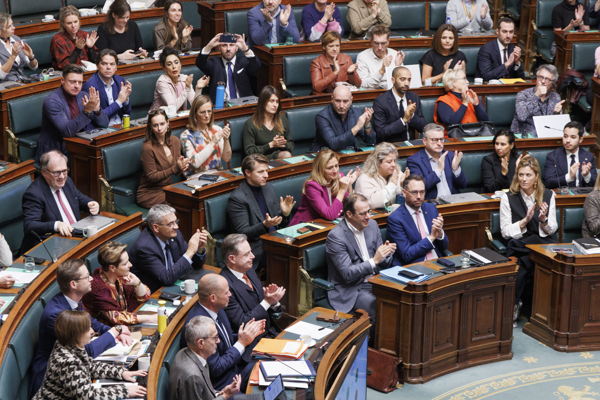
Prime minister Bart De Wever at the Chamber at the federal parliament, Brussels, 10 December 2025 © BELGA PHOTO JAMES ARTHUR GEKIERE
Related news