IMF positive on Belgium’s fiscal reform but more spending cuts needed to reduce deficit

The International Monetary Fund (IMF) has presented its annual assessment of Belgium’s economic and financial situation. Although the economy is “holding up well in the face of turbulence”, it remains “marked by large deficits and high and rising public debt”. The institution stresses the need to further reduce current expenditure.
The IMF welcomes the policies currently being pursued, saying that ongoing reforms in the areas of taxation, pensions, the labour market and healthcare should be “implemented with determination”.
However, additional efforts are needed in the face of numerous challenges “in an increasingly uncertain world”, including customs duties, the ecological transition and rising defence spending.
Public debt is expected to continue to rise until 2030 despite the reforms, while the ageing population is undermining growth forecasts and increasing costs.

Experts believe further efforts could be made in the area of pensions, where spending will continue to account for 12 per cent of GDP.
“Substantial efficiency gains could be achieved” in healthcare and education, adds the IMF, which also points to the need for better cooperation and planning of public investment between the federal government and the federated entities.
"These reforms will not be easy, and many will feel their impact directly"
In general, it recommends shifting part of the tax burden from labour to capital, as provided for in the capital gains tax.
“These reforms will not be easy, and many will feel their impact directly. But without them, the Belgian economy could take an even more brutal and painful turn for the population,” said Jean-François Dauphin, IMF mission chief.
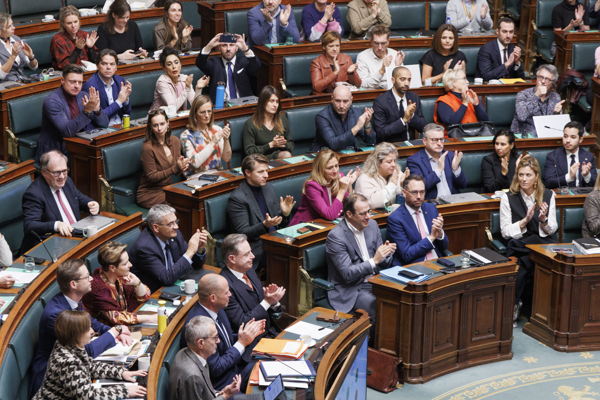
Prime minister Bart De Wever delivers his State of the Union address to Parliament after Belgium reached agreement on its multi-year budget, November 2025 © PHOTO BOB REIJNDERS / ZUMA PRESS WIRE
Related news