Flanders and Saxony sign cooperation deal on Einstein Telescope bid

Flanders and the German state of Saxony have agreed to deepen cooperation around the Einstein Telescope project, the planned underground observatory for gravitational waves. The understanding comes as the competition to host the facility moves into its final phase.
Flemish minister president Matthias Diependaele discussed post-bidding cooperation with his Saxon counterpart this week, stating that whichever site is chosen will rely on all candidates to help deliver the project. Despite Saxony’s recent alliance with a bid from Italy, he said he remained confident in Flanders’ chances.

On Wednesday, the two leaders signed a declaration expressing “their joint support for the best possible realisation of the Einstein Telescope in the common interest in Europe”. The agreement includes closer cooperation between universities and research institutions, as well as joint research, training initiatives and technology development linked to the project.
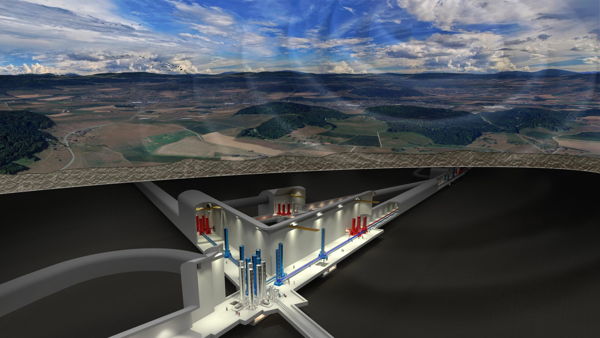
The Einstein Telescope is a next-generation underground facility designed to detect gravitational waves produced by events such as black hole collisions. Scientists say the data could provide new insight into the early universe. The project is often compared in scale and ambition to CERN in Switzerland.

Three bids are in contention: a Flemish-Dutch-German cross-border region, Saxony and Sardinia. Saxony has already partnered with Italy on a two-detector L-shaped concept, while the Meuse-Rhine bid proposes a single triangular installation. The Flemish government has pledged 500 million euros to support its proposal.
Saxony argues it has particularly strong geological conditions and has not yet confirmed its financial contribution. Minister president Michael Kretschmer said: “You have invested a tremendous amount in the preparation of this project over the past few years, wherever it may be located. In my opinion, Flanders is technologically the strongest region in Europe anyway.”
"Flanders is technologically the strongest region in Europe"
Diependaele said cooperation would be essential regardless of the outcome. “No one can do it alone,” he said. “But I believe in our own chances. The promised 500 million makes our candidacy more credible, which was also the explicit intention.”
A final decision on the location will be taken in the second half of 2027 by an independent scientific committee with no ties to the candidate countries.
#FlandersNewsService | Saxony minister president Michael Kretschmer and Flemish minister president Matthias Diependaele during a visit to Dresden by a Flemish delegation, 17 June 2026 ©BELGA PHOTO NICOLAS MAETERLINCK
Related news