Farmers’ protest in Brussels turns violent near European Parliament

Thousands of farmers from across Europe began their march through Brussels on Thursday afternoon to protest European agricultural policy. Soon after the start, the demonstration escalated into violence near the European Parliament.
The march began around 12.30pm near Brussels’ North Station on Boulevard du Roi Albert II, where various delegations had addressed the crowd earlier in the day. The demonstrators moved along the small ring road before heading towards Rue de la Loi and Place du Luxembourg, in the heart of the European quarter.
Tensions rose sharply once the protest reached the European Parliament. Demonstrators initially threw potatoes and beets at police officers, who responded by deploying a water cannon. The situation then deteriorated further, with protesters hurling stones, smoke bombs and fireworks at Parliament buildings. Tractors were also seen uprooting trees on the square.
Journalists on the ground reported verbal aggression from some protesters, who also threw objects at camera crews. Passers-by who had no connection to the demonstration were affected as well, covering their mouths and eyes with handkerchiefs as tear gas spread through the area. Several people experienced eye irritation, and some are even in shock.
The demonstration was prematurely disbanded on the small ring road at around 13:45 and will not continue to the European quarter, as was originally planned. Hundreds of farmers have split off and are heading to Place du Luxembourg.

Trade deal and budget cuts
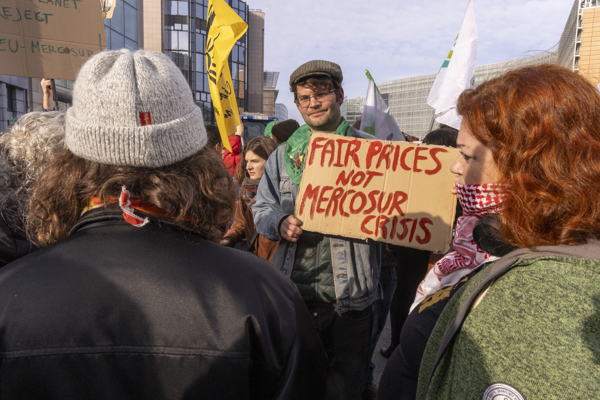
The protest coincides with a two-day EU summit in Brussels. Farmers are opposing the proposed free trade agreement with the South American Mercosur bloc, which includes Argentina, Brazil, Paraguay and Uruguay. European farmers fear unfair competition if the deal is signed.
However, the demonstrations go beyond opposition to the trade deal alone. Farmers are also protesting against European regulations that they say make investments and licensing more difficult, as well as proposed reforms to the EU’s multiannual budget, under which agricultural spending would be reduced by more than a fifth.
“European policymakers may say that agriculture is of strategic importance, but their policies do not reflect that. We demand not words, but deeds,” a speaker said ahead of the march.

PHOTOS © NICOLAS TUCAT / AFP
Related news