EU aims to deploy small modular nuclear reactors by early 2030s

The European Commission wants small modular nuclear reactors to be operational in Europe by the early 2030s. Commission president Ursula von der Leyen announced the plan on Tuesday at a nuclear energy summit in Paris, which was also attended by Belgian prime minister Bart De Wever.
In 1990, around one third of Europe’s electricity came from nuclear power, but today that share has fallen to roughly 15 per cent. "This reduction in the share of nuclear was a choice, I believe that it was a strategic mistake for Europe to turn its back on a reliable, affordable source of low-emissions power," Von der Leyen said.
The Commission president described the combination of renewable energy and nuclear power as the ideal mix for Europe’s future electricity supply. Alongside traditional reactors, she sees a key role for small modular reactors (SMRs). The new technology should be operational in Europe by the early 2030s.
"It was a strategic mistake for Europe to turn its back on a reliable, affordable source of low-emissions power"
On Tuesday, the European Commission also presented a strategy to help reach that objective. It includes a 200 million euro guarantee aimed at mobilising private investment in new nuclear technologies. The Commission also wants to work with member states to harmonise national regulations and speed up licensing procedures.
Last year, the European Commission launched an industrial alliance focused on small modular reactors and relaxed state aid rules to expand funding for nuclear fission and fissile materials. It also plans to invest more than 5 billion euros in nuclear fusion research in the next multiannual budget from 2028 onwards.

De Wever praises SMRs
Belgium's government is heavily in favour of nuclear energy. Speaking at the summit in Paris, Belgian prime minister Bart De Wever described small modular reactors as a potential driver of industrial transformation and competitiveness. "If Europe truly wants to build its strategic autonomy, it must invest in this technology," he said.
De Wever also argued that years of gradually dismantling nuclear capacity without a viable alternative had reduced Europe’s room for manoeuvre and increased dependence on external energy sources. Belgium has since reversed its earlier decision to phase out nuclear power, although the prime minister said further work is needed to "rectify this harmful legacy from the past".
"If Europe truly wants to build its strategic autonomy, it must invest in this technology"
The Belgian government now wants nuclear energy to play a structural role in the country’s future energy mix. "In the short term, this means extending our current capacity to the maximum and in complete safety. In the medium and long term, we will build new nuclear capacity, both with large reactors and with innovative technologies," De Wever said.
During his visit to Paris, De Wever also held talks with French president Emmanuel Macron. The content of the discussions was not disclosed, but according to the newspaper De Morgen, De Wever hoped to secure Macron’s support to help advance negotiations with Engie on Belgium’s nuclear energy dossier.

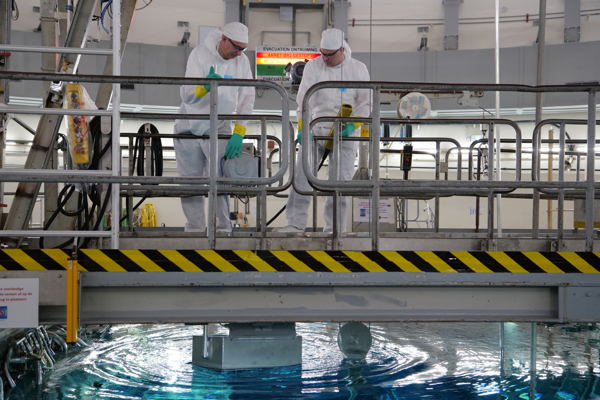
Engineers work in the Everest installation of the Poseidon departement at CEA Cadarache in Saint-Paul-les-Durance, southern France, where experimental studies on Small Modular Reactors are conducted. PHOTO © Nicolas TUCAT / AFP
Related news