Brussels coalition agreement: New mobility plan and investment in safe train stations

After 614 days, the Brussels parties have formed a government, led by the MR and with a very concise 25-page coalition agreement. The priority is to achieve a balanced budget by 2029. There will be a new mobility plan and a significant investment in the safety of train stations.
The policy statement of the future Brussels government of MR, PS, Les Engagés, Groen, Anders, Vooruit and CD&V is only 25 pages long. In the introductory text, the parties explain that everyone was aware “of the urgency and the time that has already passed since the elections of 9 June 2024”. That is why the focus was on “the Region's largest projects”.

The first chapter deals with the budget. The new government wants to achieve a balanced budget in 2029 by cutting expenditure by 80 per cent and optimising revenue by 20 per cent.
An important area for savings is the Brussels public services, which need to become much more efficient. For example, five administrations, including Finance and Budget, will be merged, which should reduce their operating costs by 20 per cent.
At the same time, there will be a substantial tax reduction to give the Brussels middle class more breathing space. Registration fees will be reduced for homes up to 800,000 euros and the discount on property tax – the onroerende voorheffing – will be doubled. By reducing personal income tax, the average working Brussels resident should have an extra 268 euros per year at their disposal.
The new government is aiming for an employment rate of 70 per cent by 2030. Today, that figure stands at around 62 per cent. There will be a compulsory language test for job seekers and job seekers who do not speak French or Dutch will have to take a language course.
In recent years, Brussels has been confronted with shootings, often linked to drug trafficking. A regional drugs commissioner will therefore be appointed, following the example of the federal drugs commissioner, to lead Brussels' approach to drugs and draw up a drugs plan. The government will also invest 10 million euros in security at train stations, particularly Brussels-South and Brussels-North.
Good Move, the much-discussed mobility plan, will be replaced by a new plan. The focus will be on smaller traffic plans around school environments and extra attention to local accessibility. In the low-emission zone (LEZ), the stricter rules will remain in force, but fines will be reduced and there will be exceptions for professional drivers and vulnerable population groups.
Metro 3, the new metro line that was to run right through the capital in the future, will only be partially completed. A small section will be finished to allow a few underground trams to run through the new tunnel at the South Station. The structural work on the rest will be completed, with a view to the future. Tram 15 will connect Tour & Taxis with the North Station. There will also be an extra car-free Sunday each year.
In recent years, there has been much discussion about certain large vacant lots in Brussels, which some parties wanted to build on and others wanted to protect as nature reserves. It has now been decided not to build for the time being and to develop a strategic vision.
Finally, the government also wants to improve cleanliness, including through underground waste containers, security patrols, camera surveillance and heavier penalties for fly-tipping.
Members of the government
The new government will be sworn in tomorrow in the Brussels Parliament. It is not yet entirely clear who will be part of the government, although it has already been confirmed that the three Dutch-speaking members of the government will remain in office. Elke Van den Brandt of Groen will remain Brussels Minister of Mobility, Public Works and Road Safety. Dirk De Smedt of Anders will retain responsibility for Budget and Finance. Ans Persoons of Vooruit will be able to continue her policy on Urban Renewal and Heritage.
It is not yet known who will become Minister-President, but the position will in any case go to the MR.
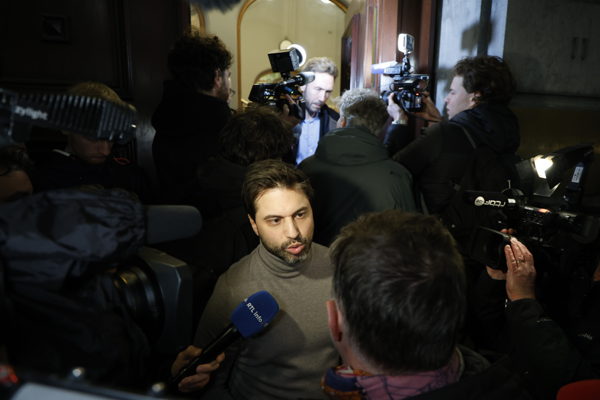
MR leader Georges-Louis Bouchez © BELGA PHOTO NICOLAS MAETERLINCK