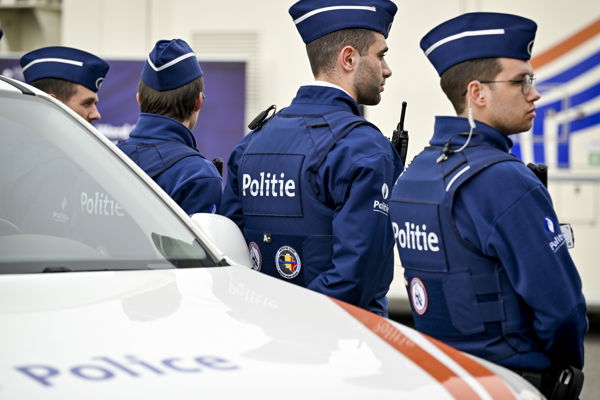
Belgium’s police forces under pressure as staff shortages and public distrust deepen

The country's police forces are under mounting pressure due to chronic staff shortages, waning public trust and renewed allegations of misconduct. Despite political promises to bolster law enforcement, the country's recruitment efforts persistently falter.
The federal judicial police in Brussels are short by at least 100 detectives, which is hindering investigations into violent and drug-related crime. In neighbouring Flemish Brabant, local authorities are struggling to retain officers, who are being lured to the capital by higher pay and bonuses. Antwerp is also experiencing a shortage of personnel, partly due to an increase in part-time working and employees taking on flexible side jobs to boost their income.
Nevertheless, the city of Antwerp announced in October that it intends to increase visible policing by 2031, relying on artificial intelligence to reduce bureaucracy and allow more time for patrols. The federal government has made similar commitments for Brussels, having called for more officers on the streets earlier this year. However, recruitment remains sluggish.
According to Eurostat, Belgium had 338 police officers for every 100,000 inhabitants in 2022, which was around the European average. The same data showed that 39,301 officers were on duty that year. However, the police have continued to experience a persistent shortage of staff in recent years.
Diversity deficit and controversial reforms
In order to attract more potential candidates to join the police force, the recruitment process has been revised to allow applicants with a criminal record to apply. The authorities insist that this does not mean that standards have been lowered, since all candidates undergo a moral integrity screening later in the process.
At the same time, the number of women joining the police force is staggering, given its poor diversity record. The inclusion of ethnic minorities, women, and disabled people lags behind that of European counterparts. According to De Standaard, women made up 32 per cent of police academy students in 2020. By 2024, this figure had fallen to 26 per cent.
Meanwhile, police forces across the country have launched high-profile recruitment campaigns and job fairs in the hope of attracting new candidates. However, the public image of policing, which is increasingly associated with excessive force and institutional arrogance, complicates these efforts.
Allegations of violence and public anger
In October, the socialist civil servants' union ACOD publicly condemned what it termed 'disproportionate violence' by the Brussels police during peaceful demonstrations. While stressing its opposition to violence against officers, the union expressed deep concern about serious incidents that occurred during protests on 2 October (a pro-Palestinian demonstration), 14 October (against the 'Arizona' government reforms) and 17 October, when the police evicted 70 undocumented migrants, including 15 children. The squatters' collective Zone Neutre echoed these accusations, stating that the police had used 'excessive force' during the eviction.
Public anger over policing practices also gained momentum in the past year. In the summer, people in Brussels took to the streets following the death of 11-year-old Fabian, who was struck by a police vehicle in Elisabeth Park. The case was widely seen not as a tragic anomaly, but as a symptom of systemic failings. As Bruzz noted, the accident 'fit into a pattern long denounced by residents and experts, of arrogance creeping into the police culture'.
While Belgium’s law enforcement struggles to fill its ranks and rebuild its credibility, the dual challenges of operational capacity and public legitimacy may be more difficult to overcome than any staffing shortage.
This article is part of a Belga English series offering insights into some of the most pressing challenges facing Belgium and Europe today. The series examines interconnected issues ranging from organised crime and public security to the pressures facing the police, the justice system, and the mental health sector. It also considers national developments within a broader European context.
#FlandersNewsService | © BELGA PHOTO EMILE WINDAL
Related News